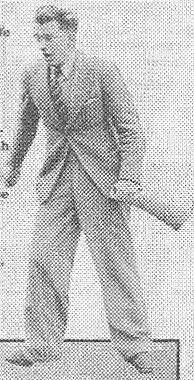
In the nineteen thirties St Giles was to Oxford what Trafalgar Square and Hyde park are to London and the nation today. Almost all protest meetings, demonstrations and marches either began or ended there. There were, of course, far fewer cars about, and the Martyr's Memorial, the War memorial andd the wide tree-lined spaces, now filled with parked cars, between the pavement and main thoroughfare on both sides of St Giles, made splendid focal points for dissent.
On most Sunday evenings Edmund and I were irresistibly drawn to St Giles to open-air meetings organised by the Communist Party and addressed by Abe Lazarus, often known as Firestone Bill because of a successful strike he had organised in the Firestone Rubber Company.
In all my years in political life I have never met anyone with a more magnetic personality than Abe. of medium height, with flaming red hair and startlingly blue eyes, his ringing voice could be heard, without the aid of a microphone, from one end of St Giles to the other.
It is said that the dons in St John's used to tremble over their port as he prophesied a workers' revolution in this country! Like Aneurin Bevin, at a later period, he had the gift of reducing people to tears at one moment and delighted laughter the next, but for me Abe's voice always rang truer than Nye's. When he talked of the starving people of Europe he could divorce me from most of my week's pocket money with one sentence although I knew, in advance, I would incur my father's wrath on returning home.
Crowded public meetings both pro and anti-fascist were also held in Oxford's Town Hall in the late thirties and I remember two in particular. One, where the platform shared by Professor Haldane, G.D.H. Cole, Victor Gollancz and Edmund's father was invaded by violent young fascists, and the meeting broken up by them. Another, addressed by Sir Oswald Mosley, where anyone in the audience daring to venture a contrary point of view was summarily and with unbelievable brutality ejected. Both Frank Pakenham (later Lord Longford) and Dick Crossman were thrown down the Town Hall stairs that night and suffered broken limbs. It was said, although I did not witness it, that the police 'looked the other way'.
Extract from Our Olive - The Autobiography of Olive Gibbs
Available at £6.95 from the publisher at 26 Norham Road, Oxford, OX2 6SF